How to find tenants for commercial property
Start from what the unit can take, match it to who lives and works nearby, then approach operators with the evidence. Try it on the example unit below.
Opens a sample report to look around. No account needed.
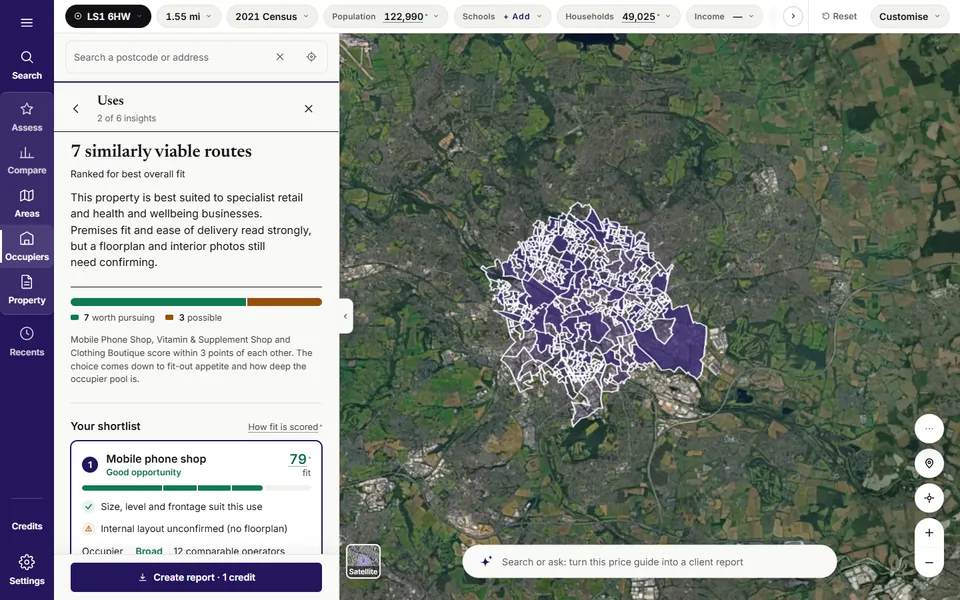
Example ground-floor unit, Sadler Gate, Derby
Example1,200 sq ft, ground floor, Class E, no extraction · Example address, not a live listing · Captured 30 September 2026
Best fits for this unit
- 1
Vitamin & Supplement Shop
Letability: clear prospecting angle with a broad operator pool
Good opportunity771. Vitamin & Supplement Shop: opportunity scoreHow well this occupier use suits this property and its catchment, from 0 to 100.Source: DemandMap, Office for National Statistics, GoogleCensus 2021 and Listings read 2026-09-30 · 2 km catchment for this useModelled estimate - 2
Mobile Phone Shop
Local demand: captures an estimated 8,334 effective people (modelled) against the 11,000 an outlet of this type typically needs
Good opportunity672. Mobile Phone Shop: opportunity scoreHow well this occupier use suits this property and its catchment, from 0 to 100.Source: DemandMap, Office for National Statistics, GoogleCensus 2021 and Listings read 2026-09-30 · 2 km catchment for this useModelled estimate - 3
Dental Practice
Rent tolerance: stronger rent tolerance than general independent retail
Good opportunity663. Dental Practice: opportunity scoreHow well this occupier use suits this property and its catchment, from 0 to 100.Source: DemandMap, Office for National Statistics, GoogleCensus 2021 and Listings read 2026-09-30 · 2.5 km catchment for this useModelled estimate - 4
Orthodontist
Rent tolerance: stronger rent tolerance than general independent retail
Possible opportunity634. Orthodontist: opportunity scoreHow well this occupier use suits this property and its catchment, from 0 to 100.Source: DemandMap, Office for National Statistics, GoogleCensus 2021 and Listings read 2026-09-30 · 8 km catchment for this useModelled estimate - 5
Optician
Rent tolerance: stronger rent tolerance than general independent retail
Possible opportunity635. Optician: opportunity scoreHow well this occupier use suits this property and its catchment, from 0 to 100.Source: DemandMap, Office for National Statistics, GoogleCensus 2021 and Listings read 2026-09-30 · 2 km catchment for this useModelled estimate
Watch for every use here: conservation area controls shopfront, signage and materials.
Ruled out by the unit
- No extraction. Hot food needs cooking extraction and this unit has none. Restaurant, Takeaway, Fast Food Restaurant, Pizza Restaurant, Fish & Chip Shop
- Wrong building type. The building type does not suit these uses. Gym
- Too small. The unit is far below the floor area these uses need.
Poor fits
- Betting Shop. This use needs planning permission and the site carries constraints that commonly refuse it
See who could take your unit.
Five steps to a letting case
The same steps whether you work them out yourself or let DemandMap rank the uses.
The method
- Start from the unit. Size, frontage, floor, extraction and use class rule out whole categories before demand matters.
- Read the catchment. Who lives and works nearby decides which of the remaining uses can trade.
- Check the competition. A use can fit the people and still be saturated.
- Check planning. A conservation area or Article 4 direction changes what a shopfront or a change of use needs.
- Approach operators with evidence. A short, sourced case for why their format fits this unit.
In DemandMap
- Enter the unit’s postcode, floor area and use class.
- See the occupier types ranked on how well the people nearby match each use.
- See the uses the unit rules out, each with the reason.
- Open the shortlist of operators trading comparable sites nearby, labelled research candidates.
- Download the landlord report with your logo on the cover.
An empty shop: start with the unit
Record floor area, frontage, servicing, extraction and the use you understand to be permitted. A busy catchment cannot rescue a format that needs space or facilities the unit lacks. Then explain which customer need the proposed use serves and why it fits this particular unit, instead of sending the same brochure to every operator.
What to send a potential occupier: a short property brief with size, facilities, local customer evidence, competing provision and the assumptions still to check. The catchment analysis and planning check pages cover two of those.
Several units: tenant mix
- Analyse uses before brands. A food-led format, a personal service and a convenience use rely on different visit patterns even when they share a catchment.
- Check duplication and complementarity. Similar businesses can create a destination or divide the same spend. Listing counts alone do not show which.
- Build a case for each unit. Repeat the assessment with each unit’s dimensions and facilities, keeping exclusions and data gaps beside each proposed use.
The tool assesses one unit at a time. It does not model a whole centre’s trading performance. Competitor mapping shows the provision around a property.
Research candidates, not leads
The operator shortlist in the app comes from real businesses trading nearby, from Google Places and checked against Companies House where possible. Each one is a research candidate showing known branches and published requirements. Requirements and expansion intent are marked unknown unless the operator has published them. Names and contact details are never invented.
Questions agents ask
- How do I find tenants for a commercial property?
- Rule out the uses the unit cannot take (size, extraction, use class), rank the rest on the local catchment and competition, then approach operators who already trade similar sites nearby with the evidence.
- What business would suit my empty shop?
- Enter its postcode, floor area and use class above. The tool ranks occupier types on how well the people within 800 m match each use and lists the ones the unit rules out.
- Does DemandMap find confirmed tenant requirements?
- No. It identifies suitable uses and operators to research. Expansion intent stays unknown unless the operator has published it, and a fit score does not mean an operator is seeking premises.
- Where do operator names come from?
- From live Google Places listings of businesses trading comparable sites nearby, checked against Companies House where possible. They appear in the app as research candidates.
- Do you give contact details?
- No. DemandMap shows who to research and why. It does not supply contact details or send outreach.
- Can tenant mix be worked out from demographics alone?
- No. Customer evidence needs to be read alongside unit constraints, existing businesses and how people use the site.
- Can I brand the landlord report?
- Yes. The landlord report in DemandMap carries your logo on the cover and downloads as a PDF, ready to send.
More for agents
- Catchment analysis Build a catchment by radius or walking time and see who lives inside.
- Planning map Designations at a site and applications within 500 m, England.
- Competitor mapping Competitors per 10,000 residents against the UK benchmark, for any postcode.
- Site selection checklist Check customers, competitors, access, premises and trading assumptions with a commercial site selection checklist before shortlisting or signing a lease.
- Before signing a lease A pre-lease checklist that fills the location checks for you.
- Commercial property agents and landlords Find potential occupiers and build a stronger case for your property.
Sources
- ONS Census 2021Checked 12 November 2026
- planning.data.gov.ukChecked 12 November 2026
- Use classes (Planning Portal)Checked 12 November 2026
- Companies HouseChecked 12 November 2026
Build the shortlist for your unit
Occupier fit, poor fits, hard exclusions and real operators to research, with the evidence for each.